⚡ TL;DR
microGREEN FX is the only 100% minority-owned and minority-run microgreens farm in Montgomery County. The scarcity is structural, traceable to Pigford v. Glickman, Section 2501 underfunding, and a century of land loss. The work speaks first, the ownership second, and the customer decides what either is worth.
Question to hold for a minute. What does it take for a county of 850,000 people, with one of the deepest small-farm traditions in the Mid-Atlantic, to produce only one 100% minority-owned and minority-run microgreens farm? 📍
The answer is not "lack of interest." It is not "lack of skill." It is structural, and the structure is on the public record. This piece walks through the structure, then walks through the working answer that got built inside it.
The Sentence That Deserves Explanation 📜
microGREEN FX is the only 100% minority-owned and minority-run microgreens farm operating in Montgomery County, Pennsylvania. The county sits at roughly 850,000 residents. Active producer listings at the PA Department of Agriculture, the USDA Census of Agriculture county tables, and the working directories that buyers and chefs use to source local microgreens all show the same single name when filtered for minority ownership in this category.
That sentence is record-keeping, not advocacy. The interesting question is why the record reads that way.
The Structural Backstory, In Five Bullets 🏛️
Pennsylvania's farm map did not arrive at this shape by accident. Five things shaped it.
1. The land-loss curve
In 1920, Black farmers in the United States held about 16 million acres. Today, less than 4 million. Pennsylvania mirrored the national curve. The acres walked away. The will to farm did not.
2. Pigford v. Glickman, 1999
The largest civil rights settlement in U.S. history at the time. Black farmers proved that the U.S. Department of Agriculture had been systematically denying loans and farm support to Black applicants from 1981 through 1996. Pigford II, in 2010, added another $1.25 billion in settlements for late filers.
3. Section 2501 underfunding
The USDA's Outreach and Assistance for Socially Disadvantaged and Veteran Farmers and Ranchers program is the federal program designed to close the access gap. It has been chronically underfunded relative to demand and relative to comparable mainstream USDA programs. The result is a thin pipeline of mentorship, technical assistance, and capital where the gap is largest.
4. Capital access and lender bias
Even when the farm is operationally tight, smaller minority-owned operations face documented friction in the lending pipeline. The friction is rarely loud. It shows up as longer underwriting timelines, smaller approved amounts, and higher rates.
5. Mentor networks and informal channels
Most working knowledge in agriculture moves through informal networks. Whose phone gets answered. Who is invited to the equipment auction. Who learns about the seed batch before the rest of the market does. Networks built across generations of land ownership are difficult to enter cold.
16M → 4M
Acres held by Black farmers, 1920 to today
$1.25B
Pigford II settlement, 2010
Add those five together across three generations and the result is exactly what the producer directories show. One farm in this category, in this county.
The Eight Stigmas That Compound the Numbers ⚖️
Beyond the structural backstory, day-to-day perception adds friction. The eight common stigmas that follow minority-owned farms around the state:
1. Less professional or less scalable
The hobby-farm read.
2. Quality and safety bias
The unconscious assumption that bigger means safer, even when the recall record reads the opposite.
3. Not traditional farmers
The image of a U.S. farmer is still shaped by white, rural land ownership. Farms outside that image get tagged as new or non-traditional even when the heritage is older.
4. Tokenization or novelty framing
Visibility offered for identity, not expertise. Looks like help, often hurts perceived legitimacy.
5. Barriers dressed as neutral standards
Stricter scrutiny from lenders or inspectors, fewer referrals, exclusion from informal channels where deals happen.
6. Land-ownership assumptions
A blanket assumption that minority farmers do not own land or are temporary. Rooted in real historical dispossession; functions as a stigma when applied universally.
7. Niche-market-only framing
Pressure to serve only specific cultural communities or grow only ethnic crops, capping market reach.
8. Under-recognition and invisibility
Missing from directories, media coverage, and research, which reinforces the false impression that minority-owned farms are rare or insignificant.
Stigma five is the one most buyers do not see. The standards are not the issue. The application of the standards is.
The Working Answer, Built On Purpose 🌱
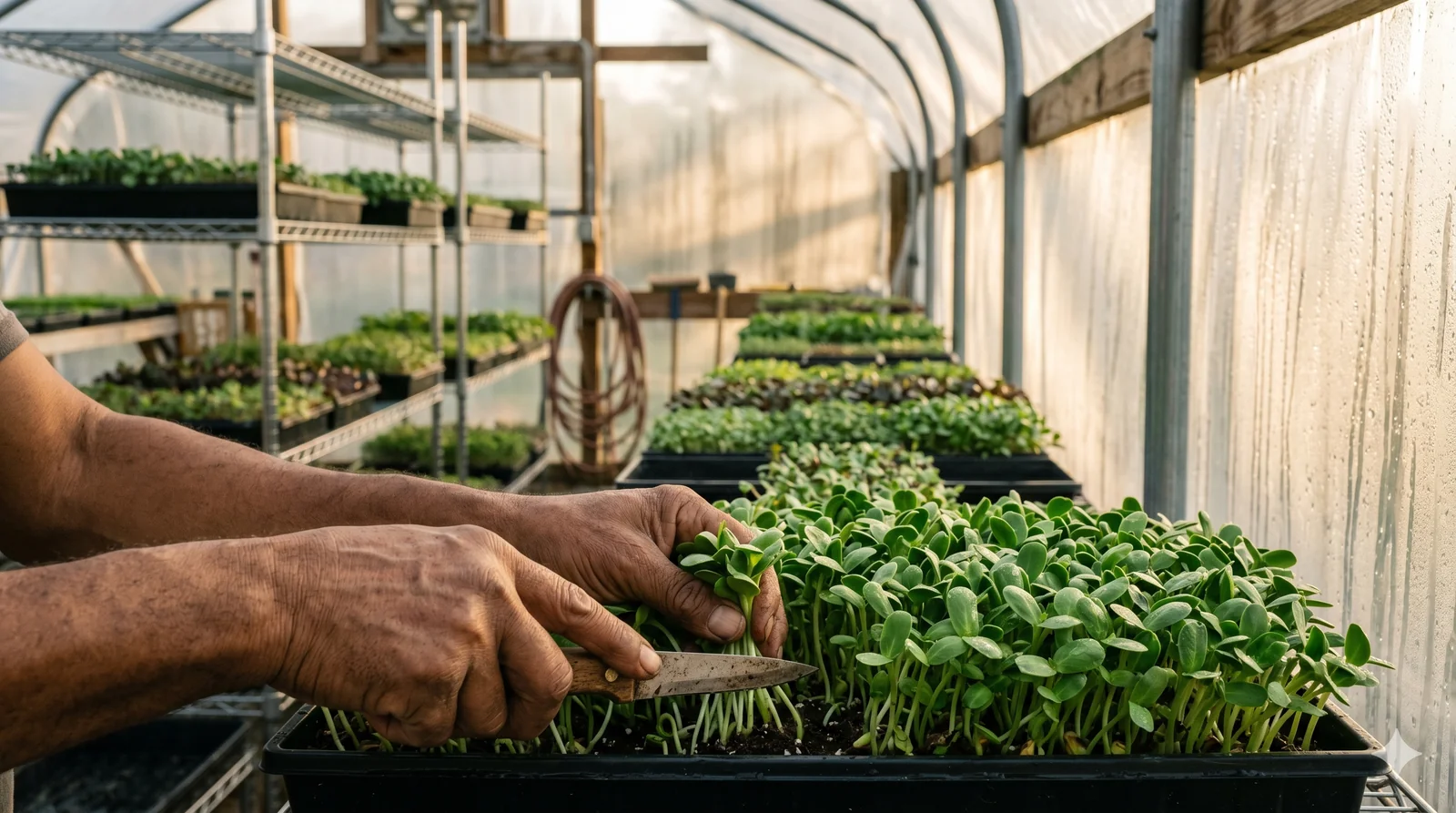
microGREEN FX exists inside that picture as a deliberate counter-example, not an exception. Sergio and Celine Markarian started the farm in Schwenksville, Pennsylvania, with three rules baked in from day one:
🚜 Build the operation tighter than the bar requires
USDA Organic seeds. Peat-free living soil reformulated in early 2022 to remove the petroleum-derived peat that most "organic" microgreens producers still use. Purified water. Zero pesticides, ever. Same-morning cut with cut-to-cold under 90 minutes. Plastic-free biodegradable packaging since the first season.
🤝 Own the customer relationship directly
No distributors. No middlemen. Sergio drives the route. The farm and the buyer talk, weekly, with no third party translating either side.
📱 Build the tools the operation needs, then share them
The GLAP app (Microgreens Grown Like A Pro) tracks every tray, schedules every transition, forecasts every harvest. It runs on iOS, Android, and the web. We built it for the farm. We made it available to other operations because the bottleneck is rarely the grower's skill; it is the grower's tooling.
Three rules. Twenty-seven varieties. Free local delivery across Montgomery, Bucks, Chester, Delaware, Philadelphia, and southeast Berks counties. PA Preferred certified. Five years of consistent operation behind the work.
Why "100% Minority-Owned and Minority-Run" Is Worth Saying Out Loud 🌍
Some operations claim minority ownership through a partial stake while the day-to-day operation runs through different hands. We are not that. The Markarian family owns the operation, runs the operation, harvests the trays, drives the route, and answers the texts. Sergio is a Family Herbalist credentialed to bring medicinal-plant knowledge into the work. Celine co-founded the farm and runs it alongside him. Their kids are part of the work too.
That is what 100% minority-owned and minority-run actually looks like. It is not a marketing label, it is the org chart.
What the Buyer's Question Should Be 🛒
Have you ever asked the farm that grew the food on your plate where its ownership sits? Most buyers have not. It is a fair question regardless of which way the answer falls, because the answer tells you something about how the dollars you spend will compound through the local economy. A longer piece on the local-multiplier math lives here.
If you are reading this from inside Montgomery County, the practical version of that question lands in one place. The operation in front of you grows pesticide-free microgreens, cuts them the morning of delivery, drops them at your door inside 8 hours, and the family that grew them lives 20 minutes away. The label on the org chart is one of several things worth knowing about the farm. It is not the only thing, and it is not the first. The work comes first. The ownership comes second. The customer decides what either is worth.
The Practical Path Forward 💵
If you want to see the work yourself, the easiest first step is a single 8oz tray from the shop. Twenty dollars, free local delivery on orders over $40 or any subscription. Order page. Weekly subscription. Same-day-harvest math for Montgomery County here.
The sentence at the top of this page would not need to be true if the playing field were already level. Until it is, the right move is to build the operation that proves the sentence wrong by being more rigorous than anything around it. That is the work. The customer makes the call.
Frequently Asked Questions 🤔
Is microGREEN FX really the only minority-owned microgreens farm in Montgomery County, PA? +
Why are minority-owned farms so rare in Pennsylvania agriculture? +
Does minority ownership change anything about the microgreens themselves? +
What is USDA Section 2501 and why does it matter for farms like microGREEN FX? +
Why does microGREEN FX talk about ownership at all instead of just selling microgreens? +
Where can I order from microGREEN FX in Montgomery County? +
Related Reading 📚
The Hobby-Farm Bias and What It Costs Buyers
Two stigmas that work against minority and small farms, and the buyer-side cost of believing them.
📱When Real Ag-Tech Comes From a Minority Farm
The GLAP app, the under-recognition pattern, and what gets reduced.
💵How $20 Compounds Through a BIPOC-Owned Local Economy
The local-multiplier math when the farm is minority-owned.
✅How to Vet a Minority-Owned Microgreens Farm Before You Buy
Practical 8-point checklist for any buyer in Pennsylvania.